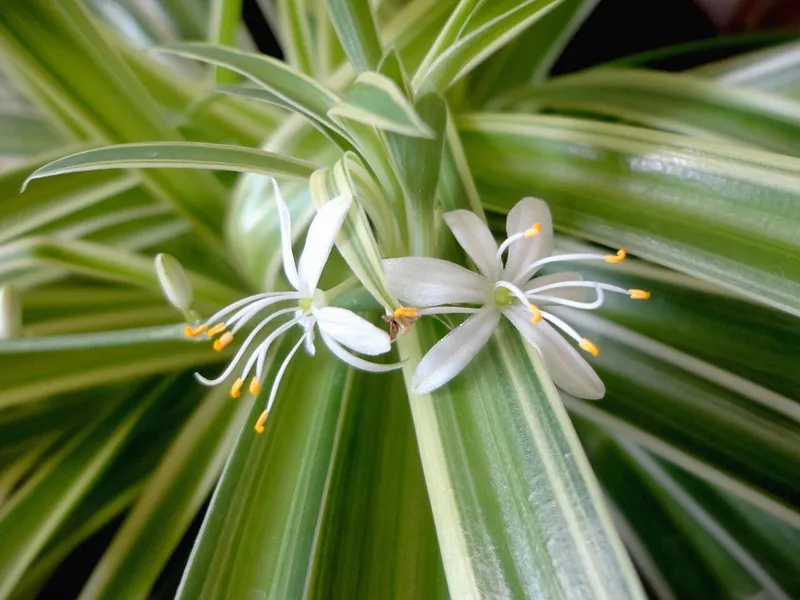
How to Propagate Spider Plant
Chlorophytum comosum
| Methods | Offsets (plantlets), water, division |
| Difficulty | Beginner |
| Best season | Spring–summer |
| Time to root | 1–2 weeks |
| Group | Houseplant |
Spider plants do most of the work for you. A mature plant sends out long arching stems tipped with miniature plants — often called spiderettes or pups — and each one is a finished plant waiting to be potted. The fastest, most reliable method is to root the pup while it’s still attached to the parent.
Each pup usually already has small brown root nubs on its underside. Those are roots waiting for contact with something damp.
Which method should you use?
Root while attached for the highest success rate and fastest result — the parent keeps feeding the pup until it’s self-sufficient. Cut and root in water if the parent is somewhere awkward to set a second pot beside. Divide the parent clump only when the pot is crowded or you want several large plants at once.
Rooting a pup while attached (best method)
- Set a small pot of moist potting mix next to the parent plant.
- Without cutting anything, lay a pup on the soil surface so its root nubs touch the mix.
- Hold it in place with a bent paperclip or hairpin.
- Keep the mix lightly moist.
- After 2–3 weeks, tug gently. If it resists, cut the runner close to the pup. It’s now an independent plant.
Rooting a cut pup in water
- Snip a pup off its runner, keeping any root nubs intact.
- Set it in a small glass with just the base in water — leaves above the surface.
- Change the water every few days.
- Pot into soil once roots reach 1–2 inches, about 1–2 weeks.
Division
- Remove the plant from its pot.
- Loosen the roots and find natural clumps. Spider plants form thick white storage roots; expect them to be tightly packed.
- Pull or cut the clump into sections, each with leaves and roots attached.
- Repot each at its original depth and water in.
When to propagate
Any time pups appear, though spring and summer root fastest. A plant that’s slightly rootbound and getting bright indirect light produces the most pups — if yours has never made any, that’s usually the fix, along with more light.
Common problems
The pup rots in water. Too much of it is submerged. Only the very base should touch water; leaves above it.
Brown leaf tips on new plants. Very common and usually cosmetic. Spider plants are sensitive to fluoride and chlorine in tap water and to dry air. Use filtered or left-out water if it bothers you.
The parent never makes pups. Usually too little light, or too young. Plants generally need to be a year or more old, and they flower and pup more readily when snug in their pot.
Pups are small and pale. They’re growing in low light or the parent is short on nutrients. Feed the parent during the growing season.
Questions people ask
Do I have to wait for roots before cutting the pup off? No, but it’s easier. A pup with no roots will still root in water or moist soil; it just takes a little longer.
How many pups can one plant support? Many at once — a healthy plant can carry a dozen. Removing some redirects energy into the parent.
Can I plant several pups in one pot? Yes, and it looks fuller much faster. Three to five in a 6-inch pot works well.
Related
Soil & cutting methods hub · Water propagation hub · Similar plants: Chinese Money Plant, Bromeliad, Aloe Vera