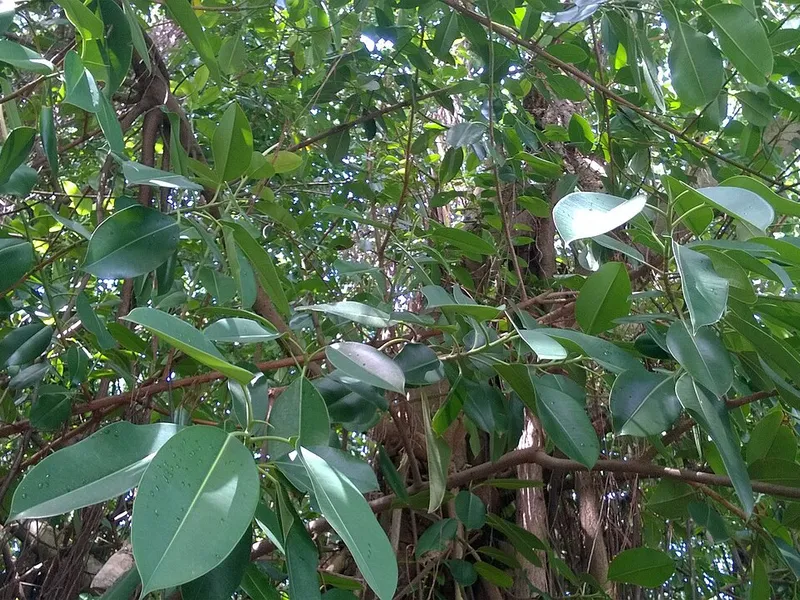
How to Propagate Rubber Plant
Ficus elastica · Also called Rubber Tree
| Methods | Stem cutting, air layering |
| Difficulty | Intermediate |
| Best season | Spring–summer |
| Time to root | 4–8 weeks |
| Group | Houseplant |
Rubber plants root more willingly than their close relative the fiddle leaf fig, but they share the same two requirements: a node on the cutting, and patience while the milky sap stops flowing. That sap is latex — it irritates skin, stains fabric, and is toxic if swallowed.
Most people propagate this plant because it has grown into a single tall bare stem. Cutting the top off solves both problems at once: you get a new plant, and the parent branches out below the cut.
Which method should you use?
Air layering for a tall leggy plant you want to shorten without risk — you get a large rooted plant immediately and the stump resprouts. Stem cuttings for smaller pieces and side branches.
Stem cutting
You need: clean sharp snips, a damp cloth, a pot of well-draining mix, a clear bag.
- Take a 6–8 inch section with 2–4 leaves and at least one node.
- Cut an inch below the lowest node.
- Blot the bleeding latex with a damp cloth until it stops — a few minutes. Wash your hands.
- Remove the lowest leaf. Roll the remaining large leaves upward and secure loosely with a rubber band to cut water loss.
- Dip the cut end in rooting hormone (helpful here).
- Bury the node 1–2 inches in moist mix. Tent a clear bag over it.
- Bright indirect light, warm room.
Roots in 4–8 weeks. Water rooting also works but produces weaker roots than soil for this plant.
Air layering
- Choose a point on the stem below the leaves, where you want the new plant’s base.
- Cut a ring of bark about an inch wide right around the stem and remove it.
- Blot the sap, dust with rooting hormone.
- Wrap in damp sphagnum moss, cover with plastic, tie both ends.
- Keep the moss damp; roots fill it in 4–8 weeks.
- Cut below the roots and pot up.
When to propagate
Spring and summer. Warmth drives rooting for all Ficus — below about 65°F progress nearly stops. Prune and propagate at the same time in late spring for the best recovery on the parent.
Common problems
The cutting dropped its leaves. Water loss. Use the bag, roll the leaves, keep out of direct sun.
Base turned black and soft. Rot — mix too wet or too dense. Use chunky well-draining mix and water only when the surface dries.
Sap keeps flowing and the cutting looks weak. Blot until it fully stops before planting; a continuously bleeding cut struggles to seal and root.
The parent stump did nothing after I cut the top off. Give it time and bright light. New buds usually break from just below the cut within a few weeks in the growing season.
Questions people ask
Can I root a single rubber plant leaf? It will root and survive as a leaf, but with no node it never grows into a plant.
Is the sap dangerous? It’s a skin and eye irritant and toxic if eaten. Wear gloves if you have sensitive skin; keep it away from pets and children.
Will the variegated types stay variegated? Yes — unlike snake plants, Ficus variegation is genetic and passes to cuttings.
Related
Soil & cutting methods hub · Similar plants: Fiddle Leaf Fig, Ficus Audrey, Weeping Fig