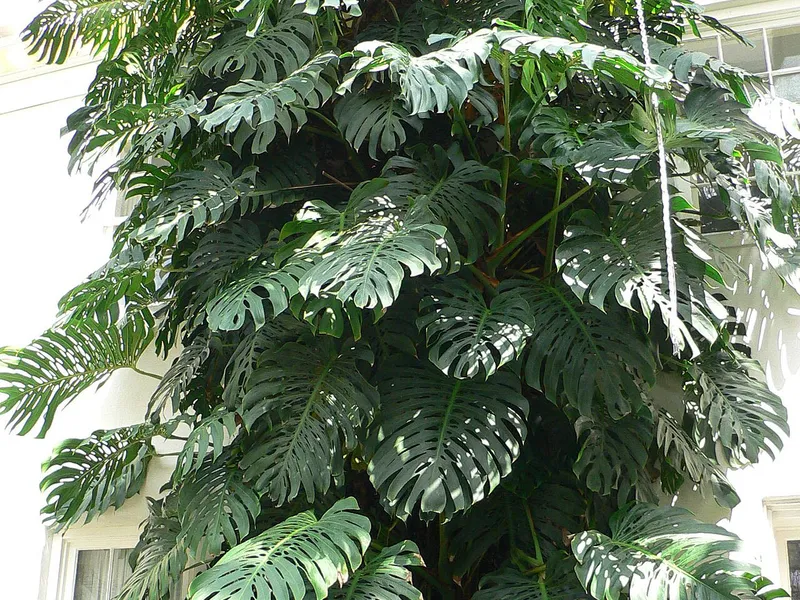
How to Propagate Monstera
Monstera deliciosa · Also called Swiss Cheese Plant, Split-Leaf Philodendron
| Methods | Stem cutting, water, air layering |
| Difficulty | Beginner |
| Best season | Spring–summer |
| Time to root | 3–6 weeks |
| Group | Houseplant |
Monstera propagates easily from a stem cutting — but only if the cutting includes a node. A single leaf, however large and beautifully split, will sit in water looking healthy for months and never grow roots. This is the most common and most disappointing mistake with this plant.
The node is the thickened band on the stem where a leaf and often an aerial root emerge. Cut below one and you have a future plant; cut above it and you have a decoration with an expiration date.
Which method should you use?
Water if you want to watch the roots and reassure yourself it’s working. Soil if you’d rather skip the transition. Air layering if the plant is large or valuable and you don’t want to risk cutting a piece off before it has roots — it’s the safest method, and the one to use on a mature specimen.
Stem cutting (water or soil)
You need: clean sharp snips or a knife, a jar or a pot of chunky well-draining mix.
- Find a node — the raised ring on the stem, usually with a brown aerial root nub near it.
- Cut about an inch below the node. Ideally include one leaf and one aerial root.
- If it’s bleeding sap, let it sit 20 minutes before putting it in water.
- Water: submerge the node and aerial root; keep leaves dry. Change water weekly. Soil: bury the node an inch deep in moist chunky mix.
- Bright indirect light, warm room.
Roots start in 3–6 weeks. Pot up when they’re 2–4 inches long.
Air layering
Best for large plants. You root the stem while it’s still attached, so the cutting is never without a root system.
- Pick a node with an aerial root on the main stem.
- Wrap a fistful of damp sphagnum moss around the node.
- Wrap the moss in plastic and tie both ends, leaving it slightly loose.
- Keep the moss damp — open it and mist every few days.
- When roots fill the moss (4–8 weeks), cut below the node and pot it.
When to propagate
Spring through late summer. Growth slows sharply in winter and a cutting taken in January can take three months instead of one. Warmth matters more than anything — Monstera roots fastest above about 70°F.
Common problems
The cutting has been in water for months with no roots. No node. Check the stem for the raised ring; if the cutting is a leaf and a bare stalk, it can’t root. Start again.
The stem turned brown and soft. Rot, from stale water or soggy soil. Change water weekly; use chunky mix with bark or perlite for soil rooting.
Roots grew but the leaf yellowed. Usually normal — the cutting used stored energy. If several yellow at once, it’s too much light or the water needs changing.
Sap got on my skin and it itched. Monstera sap contains calcium oxalate crystals, which irritate skin and are toxic if eaten. Rinse with soap and water, and keep cuttings away from pets and children.
Questions people ask
Can I propagate from just an aerial root? No. Aerial roots don’t produce new growth on their own — you need a node.
How many leaves should a cutting have? One or two is ideal. More leaves means more water demand before there are roots to supply it.
Will the cutting have split leaves? Not right away. New leaves start small and solid; splits and holes develop as the plant matures and gets good light.
Can I cut the main stem in half? Yes. As long as each piece has a node, both the top and the rooted base will grow.
Related
Water propagation hub · Soil & cutting methods hub · Similar plants: Swiss Cheese Vine, Mini Monstera, Pothos